

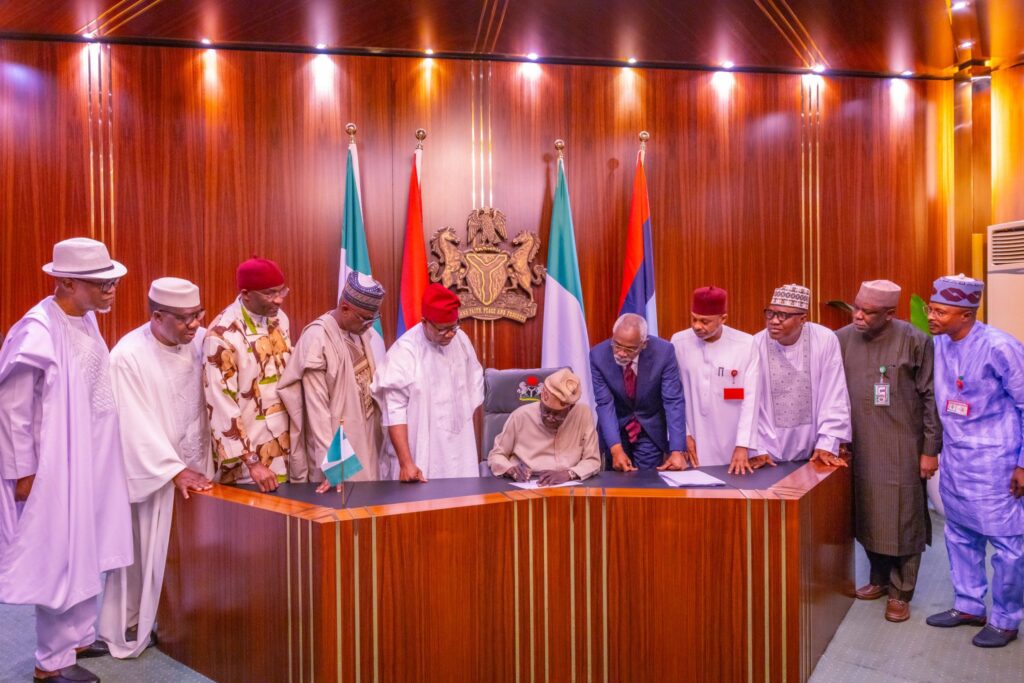
President Bola Tinubu has officially signed the Electoral Act, 2022 (Repeal and Re-Enactment) Bill 2026 into law.
The bill was signed on Wednesday at the Presidential Villa in Abuja, and in attendance were Senate President Godswill Akpabio, Speaker of the House of Representatives Tajudeen Abbas, Deputy Speaker Benjamin Kalu, Chief of Staff to the President Femi Gbajabiamila, Senate Leader Opeyemi Bamidele, House Leader Julius Ihonvbere, as well as other senators and members of the House of Representatives.
The move comes after the National Assembly passed the bill on Tuesday, following months of legislative deliberations and engagement with civil society groups.
The bill, which is set to govern the conduct of elections ahead of the 2027 general elections, has sparked heated debates in recent weeks, with lawmakers and prominent Nigerians disagreeing over provisions, particularly over Clause 60(3), which mandates electronic transmission of results from polling units to the INEC Result Viewing Portal (IReV).
The clause also allows presiding officers to rely on Form EC8A for manual collation if electronic transmission fails. This provision was intended to safeguard the integrity of results while ensuring the process remains transparent and inclusive.
During Senate deliberations, the upper chamber initially faced disagreement over the clause, prompting a rescission and re-passage of the bill to address technical inconsistencies and ensure all electoral timelines promoted maximum participation, fairness, and administrative efficiency.
The final passage retained the proviso on Clause 60(3), reflecting lawmakers’ intent to balance innovation in electronic result transmission with practical safeguards against potential system failures.
According to the Senate, the decision to retain the proviso followed a detailed review by a technical committee comprising the leadership of both chambers, members of the conference committee, clerks, and legal drafting experts from the National Assembly, who harmonized the bill and corrected discrepancies across multiple clauses to ensure consistency and clarity.
Process, Not Politics
Speaking after signing the bill, President Tinubu said the amendments were aimed at strengthening Nigeria’s electoral process rather than advancing political interests.
“After every election cycle, we owe Nigerians an honest look at what worked and what must work better. That is how serious democracies behave, and our laws must grow with experience,” the President said.
He added, “These amendments are not about politics. They are about process. They are about closing gaps, strengthening procedures, and providing greater clarity to those who conduct and participate in our elections.”
Tinubu stressed that voter confidence must remain central to electoral reforms.
“When citizens walk into a polling unit, they must do so with confidence. When results are declared, they must be trusted. That confidence is built deliberately, and not by chance,” he stated.
The President also commended the National Assembly for what he described as its cooperation and sense of national responsibility in concluding the legislative process.
“Our responsibility remains to keep improving the system so that the people’s will is expressed clearly, peacefully, and credibly. The work of strengthening our democracy continues, and we shall not relent,” he said.
With presidential assent now complete, the bill is formally law, setting the stage for its implementation across the country’s electoral processes.