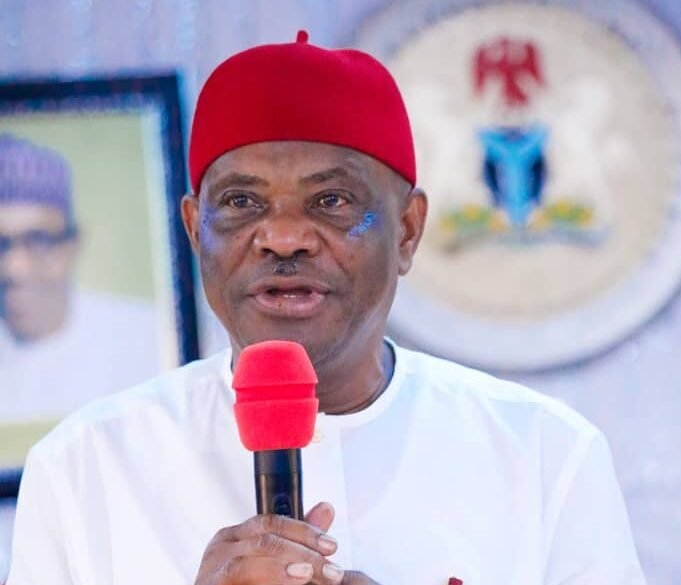

The Minister of the Federal Capital Territory (FCT), Mr. Nyesom Wike, has come under intense criticism for a violent remark made during a live media briefing on Friday, April 3.
Addressing other journalists, Wike stated, “If there was any way to break the screen, I would have shot him,” in reference to renowned journalist Seun Okinbaloye.
The comment came in reaction to a statement made by Okinbaloye during an earlier edition of Channels Television’s Politics Today, in which the journalist discussed concerns over Nigeria’s political trajectory, including the country’s perceived drift toward a one-party state.
While Wike later clarified that he had no intention of physically harming the journalist, press freedom advocates have condemned the statement as a conditional threat, noting that such rhetoric, even if hypothetical, can intimidate journalists and undermine public trust in democratic discourse.
A coalition of press freedom and civil society organizations, including the International Press Institute (IPI), Media Rights Agenda (MRA), Enough is Enough Nigeria (EIE), and the International Centre for Investigative Reporting (ICIR), called on Wike to retract his statement, issue an apology to Okinbaloye and the media community, and reaffirm his commitment to non-violence and press freedom.
The groups highlighted Nigeria’s low ranking—122 out of 180 countries—on the World Press Freedom Index, noting that journalists routinely face monitoring, attacks, and arbitrary arrests.
Amnesty International also condemned Wike’s remarks, describing them as “reckless and violent” and warning that they risk normalizing attacks on journalists.
The organization noted that the statement violated the Nigerian Broadcasting Code, which is enforced by the Nigerian Broadcasting Commission (NBC), and urged the minister to withdraw the statement immediately and apologize.
The controversy follows Okinbaloye’s coverage of a leadership dispute within the ADC and recent decisions by the Independent National Electoral Commission (INEC), which had formed the context for the journalist’s commentary.