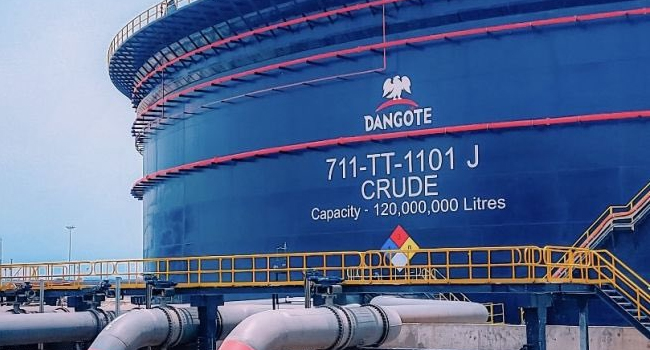

The Dangote Petroleum Refinery has commenced direct aviation fuel deliveries to international carriers, including Ethiopian Airlines, as global supply disruptions linked to tensions between the United States and Iran continue to tighten fuel markets.
Speaking at an energy conference in Lagos, the refinery’s Managing Director, David Bird, said the facility had begun exporting jet fuel, diesel and petrol after achieving sufficient output to meet domestic demand.
He noted that since the onset of the Middle East crisis in late February, the refinery has supplied refined petroleum products to 11 African countries, underscoring its growing export capacity.
“We’re proud to have done a direct delivery to Ethiopian Airlines, and we will continue to export surplus production to neighbouring African countries,” Bird said.
According to him, the refinery is currently operating at full capacity following earlier maintenance, enabling it to respond to rising global demand for aviation fuel amid widespread shortages affecting both developed and emerging economies.
Global oil prices have recently surged to about $112 per barrel, driving up aviation fuel costs. Bird, however, stressed that availability remains a bigger concern than price volatility.
“What is worse than $100 or $120 oil is no oil at all,” he said, citing supply constraints in import-dependent countries such as Australia, Bangladesh, Sri Lanka and the Philippines.
Despite global pressures, Bird maintained that Nigeria’s domestic fuel supply remains stable due to increased local refining capacity, largely driven by investments from Aliko Dangote.
Industry data indicates that the refinery is benefiting from strong profit margins on jet fuel exports, particularly to Europe, where demand has surged due to peak summer travel. Imports from Nigeria reportedly reached between 78,000 and 96,000 barrels per day in April.
Analysts estimate that while European refiners earn around $15 per barrel, margins at the Dangote facility are more than double, supported by access to locally sourced crude and the plant’s large-scale operations.
An executive at the refinery, Devakumar Edwin, disclosed that the plant produces about 24 million litres of jet fuel daily. While a significant portion is exported, it also supplies Nigerian airlines, whose total daily demand is estimated at about 2.1 million litres.
However, rising fuel prices continue to strain the aviation sector, with domestic carriers warning of possible disruptions as operating costs climb.
The refinery sources crude from the United States, other African producers and Brazil, positioning it as a major player in global refined fuel markets.
Originally designed to make Nigeria a net exporter of petroleum products, the Dangote Refinery is increasingly influencing fuel supply dynamics across Africa and beyond, even as global energy markets remain volatile.