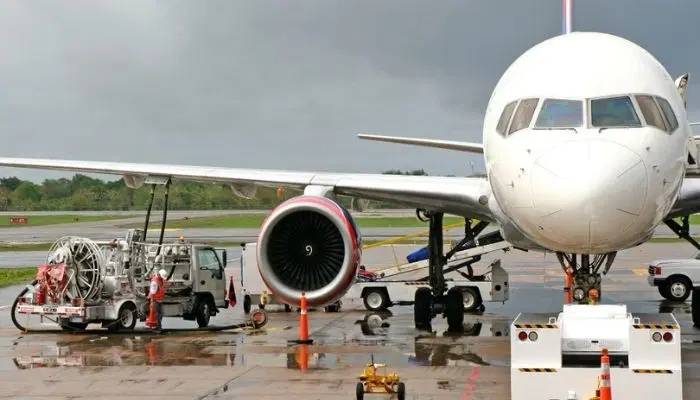

Despite a pricing advisory issued by the Nigerian Midstream and Downstream Petroleum Regulatory Authority (NMDPRA), oil marketers have continued to sell aviation fuel, also known as Jet A1, at rates of N2,230 per litre and above, intensifying pressure on Nigeria’s aviation industry.
The regulator had earlier recommended a pricing band of between N1,760 and N1,988 per litre in Lagos, and about N2,037 per litre in Abuja, based on prevailing market fundamentals. The guidance followed stakeholder engagements involving airlines, marketers, depot owners and other players in a bid to resolve pricing disputes.
However, market checks indicate that actual transactions remain significantly higher than the advised range, with airlines still paying as much as N2,230 per litre.
Industry sources attribute the persistent high prices to strong demand and the role of intermediaries within the supply chain, who are said to be exploiting arbitrage opportunities. The multi-layered distribution process from depot to end-users has continued to exert upward pressure on final prices.
Findings further revealed that the Dangote Petroleum Refinery currently has aviation fuel in stock, with a gantry price of about N1,800 per litre. However, middlemen lifting the product reportedly apply significant markups before supplying to airlines, pushing prices well above the regulatory benchmark.
The widening gap between the advised and actual prices has raised concerns about inefficiencies in distribution and the limits of regulatory influence in a largely deregulated downstream sector.
Reacting to the development, Chief Executive Officer of Petroleumprice.ng, Olatide Jeremiah, called for greater transparency in pricing.
“Dangote Refinery should, as a matter of urgency, publish its daily jet fuel gantry prices. This would erode abnormal margins by middlemen and help curb artificial price hikes threatening the aviation sector,” he said.
Airline operators have also expressed concern over the impact of rising fuel costs on operations. Spokesperson for United Nigeria Airlines, Chibuike Uloka, noted that the situation has significantly increased operational expenses across the industry.
He explained that while the NMDPRA can only provide guidance in a free market, marketers have continued to operate independently without enforcement of the suggested pricing range.
According to him, fuel costs for a single flight operation, which stood at about N2.9 million earlier in the year, have risen sharply, with some airlines now spending as much as N7.6 million or more, depending on aircraft type and route.
Similarly, Managing Director of Aero Contractors, Ado Sanusi, stressed the need for a transparent pricing framework.
“We should know what price Dangote is selling at and the landing cost for imported fuel. That way, we can establish a benchmark and prevent exploitation,” he said.
Meanwhile, the Aviation Round Table Initiative (ARTI) has warned that the continued surge in Jet A1 prices could cripple domestic airlines if urgent measures are not implemented.
In a letter addressed to President Bola Tinubu and Minister of Aviation, Festus Keyamo, the group proposed a temporary fuel price stabilisation mechanism, including a time-bound refund system and negotiated supply contracts to cushion the impact of price volatility.
The group also advocated emergency financial support for airlines, including low-interest loans and working capital guarantees, alongside broader reforms to improve transparency, reduce charges, and stabilise the aviation ecosystem.
Stakeholders warn that unless supply chain inefficiencies and pricing distortions are addressed, airlines may be forced to pass rising costs onto passengers, potentially affecting ticket prices and overall sector stability.
The letter read: “To stabilise the system, the first step is a corrective, time-bound Jet-A1 refund mechanism. This is not a subsidy but a temporary parity-restoration measure.
”Government should contract six months of Jet A1 supply at negotiated parity prices, covering the hardship period of February to April 2026, and extend corrective supply for an additional four months while global markets stabilise.
”This mechanism must be transparent, audited and publicly reconciled to ensure that refinery-gate prices align with depot and gantry prices.
“Next, a narrowly targeted emergency stabilisation package for airlines is essential. Airlines require short?term, low-interest bridge loans and working-capital guarantees to cover immediate cash?flow shortfalls and essential operational costs. These funds must be tied to strict milestones: safety compliance, payroll continuity, and uninterrupted essential services. Each airline should submit a concise liability-cleanup plan detailing how funds will be used to retire or restructure verified debts to ground handlers, fuel suppliers and agencies. All support must be conditional on independent verification and governed by a strict sunset clause to prevent the emergence of permanent subsidies.
“Parallel measures must protect ground handlers, concessionaires, and other service providers while airlines are stabilised. Options include emergency liquidity advances, short?term rent freezes or deferrals, and promissory commitments for verified renovation and investment losses. A 30 per cent mandated haircut on specified debts—consistent with the approach already applied to agencies—may be necessary, but it must be used sparingly, only after independent valuation, and only for verified operational receivables. Any such relief must be paired with protections for frontline workers, including wage continuity and severance guarantees, and must include safeguards against moral hazard.
“To ensure transparency and accountability, a neutral reconciliation vehicle should be established to process payments, advances, and concessions. Each beneficiary should receive a one?page reconciliation statement, and an independent auditor should certify outcomes at the end of the relief window. No entity receiving support should be allowed to compromise safety, maintenance, training, or regulatory compliance.
“Beyond emergency measures, structural reforms are indispensable. A comprehensive overhaul of the aviation charging ecosystem is overdue. A top global advisory firm should be engaged to audit airport charges, passenger levies, navigation fees, parking and ground?handling tariffs, and other provider charges. This review must benchmark Nigeria against international standards, eliminate duplications, and produce a phased roadmap to reduce the share of taxes and charges embedded in fares. These reforms should be accompanied by revenue?transition plans for affected operators to ensure sustainability.
“To prevent future crises, a National Energy Price Protection Program, NEPPP, should be established. These rules?based frameworks should include a volatility buffer fund, mandatory price transparency across the supply chain, and a logistics?cost rationalisation audit. The Federal Competition and Consumer Protection Commission should be empowered to investigate refinery-to-gantry spreads, airport delivery margins, and any anti?competitive practices that distort pricing.”