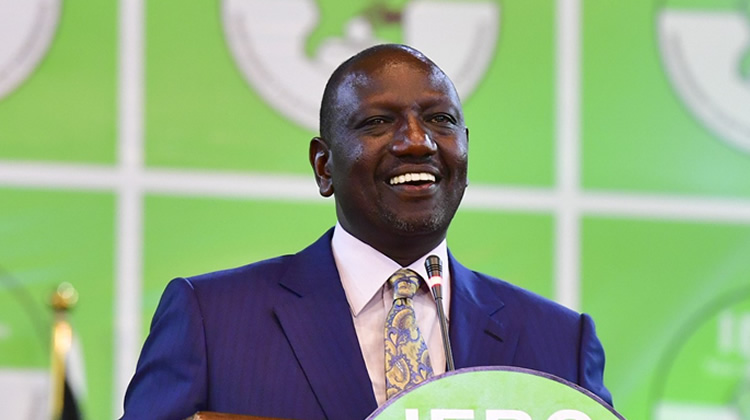

Kenyan President William Ruto has defended his recent comments on English proficiency and education standards in Africa, saying his remarks were misinterpreted and taken out of context following online criticism.
Speaking at the Mining Investment Conference and Expo in Nairobi on Tuesday, and broadcast by NTV Kenya, Ruto said the comments originated from a private conversation that was later made public without proper context.
“Please pass my regards, Minister, to President Tinubu, my friend, and to the great people of Nigeria, who are my in-laws, and do so in good English,” he said, referring to Nigeria’s President Bola Ahmed Tinubu.
He added: “And, you know, I was captured, I was speaking to my fellow citizens somewhere, and somebody, it was supposed to be a private conversation, but somebody decided that it should be public. But they also misrepresented the facts.”
Ruto insisted that his intention was to highlight broader discussions about English proficiency across African countries, not to disparage any nation.
“The facts are that I was talking about how we in Africa speak very good English, all of us. In fact, in some countries like Nigeria, if you don’t speak excellent English, like the one we speak in Kenya, you may need a translator,” he said.
“So that was the comparison, but somebody decided to take it out of context. But I think it is as well that we can have this conversation. And my in-laws, I hope there will be no consequences for whatever was done,” he added.
The clarification comes after a video clip circulated online showing the Kenyan president praising his country’s education system while appearing to contrast it with Nigeria’s English usage.
In the widely shared clip, Ruto was quoted as saying Kenya’s education system produces strong English speakers and suggesting that Nigerians sometimes require clarification to understand speech.
Although he did not mention any individual, the remarks were widely interpreted online as responding to recent comments made by President Tinubu during a visit to Bayelsa State on April 10, 2026, where he compared socio-economic conditions across African countries.
The exchange has since generated debate on social media, with users across the continent discussing the tone and interpretation of statements made by the two leaders and what it reflects about diplomatic communication in Africa.