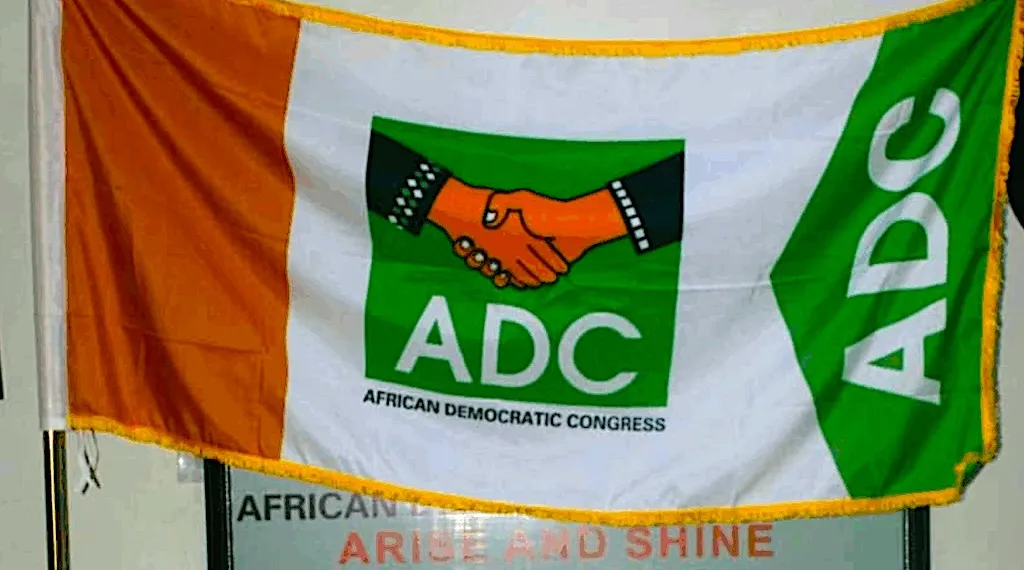

The African Democratic Congress (ADC) has accused the Federal Government of applying justice selectively in the ongoing legal cases involving former Kaduna State Governor, Mallam Nasir El-Rufai, and former Attorney General of the Federation, Abubakar Malami (SAN), both members of the opposition party.
In a statement signed by its National Publicity Secretary, Mallam Bolaji Abdullahi, on Tuesday, the party raised concerns about the speed and manner of enforcement actions against the two leaders, contrasting it with a separate high-profile case involving allegations of passport forgery and international conspiracy, where the accused were granted bail and court proceedings are reportedly moving swiftly.
The ADC criticized the rapid movement of Malami and El-Rufai from one detention facility to another while investigations remain ongoing, questioning whether custody is being used as an investigative shortcut or a means to sideline opposition figures. The party emphasized that in a constitutional democracy, custody should follow credible charges and not create the appearance of pre-trial punishment.
According to the party, Nigerians cannot accept situations where legal instruments appear to move unusually fast against opposition leaders while similar cases elsewhere proceed at a slower pace, highlighting concerns about fairness, consistency, and transparency in law enforcement.
It also reiterated that both Malami and El-Rufai remain entitled to the constitutional presumption of innocence until proven guilty by a competent court of law and vowed to stand by its members as they assert their legal rights.
The full statement from the ADC reads:
The African Democratic Congress, ADC, has been monitoring the ongoing legal cases involving two of our leaders, Mr. Abubakar Malami, former Attorney General of the Federation and Minister of Justice from Kebbi State, and Mallam Nasir El-Rufai, former Governor of Kaduna State.
As a law-abiding party, it is important to state for the record that the ADC believes no citizen, regardless of stature or past office, is above the law. However, in a constitutional democracy where the law is seen to operate selectively, it becomes imperative to insist, firmly and without apology, that justice must be applied evenly, transparently, and without political calculation, particularly in cases such as those involving Abubakar Malami and Nasir El-Rufai, where the manner, speed, and sequence of enforcement actions have understandably raised serious public concern about consistency and fairness.
The movement of Malami and El-Rufai from the custody of one law enforcement agency to another, in rapid succession, while investigations appear ongoing, has raised profound public concern. When a citizen is transferred from one detention facility to another before investigations are demonstrably concluded, it inevitably begs the question: is detention being used as an investigative shortcut, or as an instrument of pressure to keep these opposition leaders out of circulation? In a democracy that is supposed to be governed by the rule of law, custody must follow credible, well-prepared charges, not precede them in a manner that creates the appearance of pre-trial punishment.
If there is evidence against Abubakar Malami, prosecute him transparently. If there is evidence against Nasir El-Rufai, present it before the court and allow the law to take its course. But Nigeria and Nigerians will not accept a situation where the coercive instruments of the Bola Tinubu-led federal government are perceived to move with unusual speed against opposition figures, while similar matters elsewhere travel at a gentler pace.
Nigerians should consider a recent high-profile case. At its center are grave allegations of passport forgery, international conspiracy, impersonation, and the alleged use of a disputed international passport in support of a property claim in London. These are not minor procedural questions. Yet, in that case, the accused persons pleaded not guilty, were granted bail, and the matter is proceeding with dispatch before the court.
Yet, in the cases involving Abubakar Malami and Nasir El-Rufai, we have witnessed prolonged custodial movements, inter-agency transfers, and processes that appear to precede, rather than follow, fully crystallized prosecution.
At the same time, let there be no ambiguity about our position. Abubakar Malami and Nasir El-Rufai are first citizens of Nigeria before they are opposition leaders or members of the African Democratic Congress. They are therefore presumed innocent under the Constitution until proven otherwise in a fair and competent court of law. That presumption should not be treated as a courtesy, but as a constitutional guarantee.
We will continue to stand by our members as they assert their legal rights. We will ensure that they are not isolated, intimidated, or denied the protections that every Nigerian citizen is entitled to under the law. We will never abandon our people in moments of trial. We will never leave any of our members behind. To stand by them is not to obstruct justice, it is to insist that justice is done properly.
Accordingly, ADC calls for immediate public clarification from the relevant authorities on the precise status and stage of investigations concerning Abubakar Malami and Nasir El-Rufai, strict adherence to constitutional safeguards protecting against arbitrary or prolonged detention, transparent and time-bound prosecution of any charges supported by credible evidence, and equal application of the law without discrimination based on political alignment.
In moments such as this, nations define themselves. ADC chooses to define Nigeria as a country that is founded on the equal application of the law, not a country that is governed by the whims of the executive branch. As a party, we also choose to insist that justice must be impartial, consistent, and immune from any political mathematics and machinations.